
Appearance
ActualLab.Rpc - the fastest RPC protocol on .NET
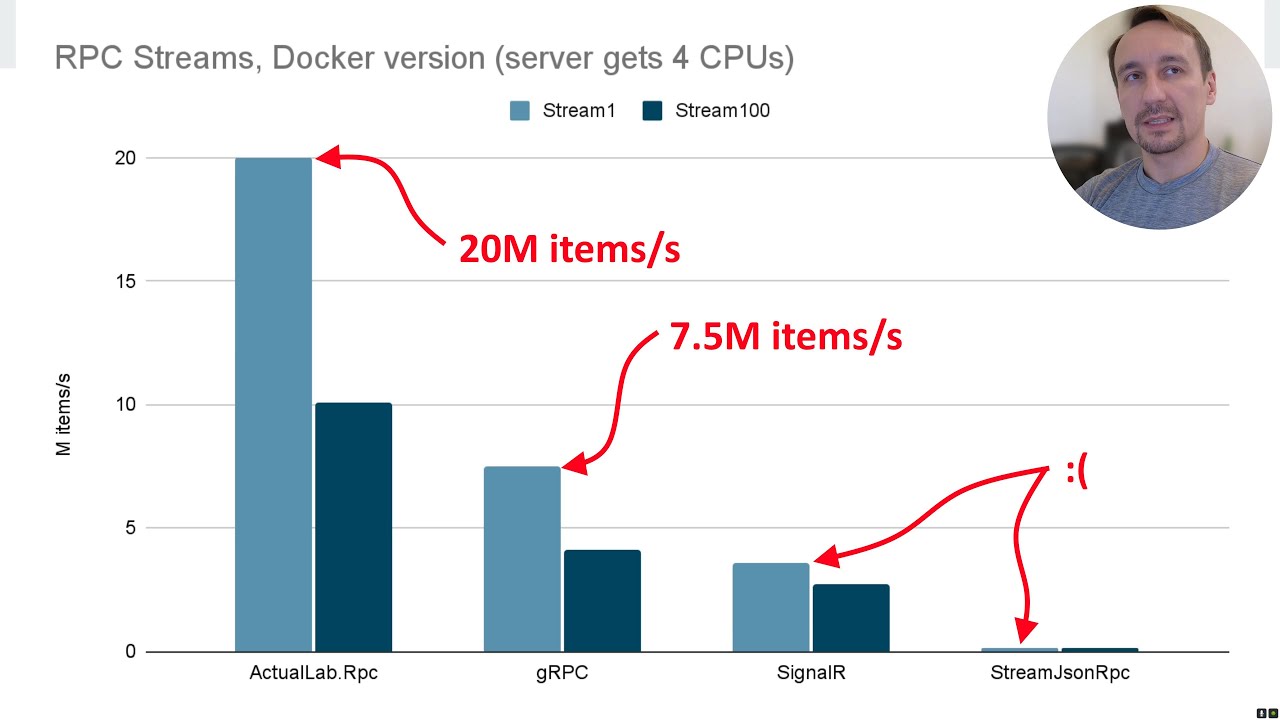
Table of Contents
- Introduction and Background (0:00)
- What is Fusion (1:06)
- History with HTTP (1:57)
- Problems with HTTP (2:04)
- Building Own Protocol (4:12)
- ActualLab RPC Features (5:54)
- Performance Highlights (10:01)
- Benchmarks (18:11)
- Comparison with Other Protocols (22:08)
- Demo (39:03)
- Code Explanation (42:48)
- Mesh Demo (55:59)
- Conclusion (1:02:33)
Transcript
00:00:00 so a little bit more on uh like who am
00:00:07 I um you can find me on medium I uh
00:00:13 wrote uh a number of posts related to Performance these are some of the uh
00:00:19 kind of uh more uh interesting ones uh
00:00:25 then um I'm also the creator of uh actual
00:00:32 chat uh you can try the app and uh um my
00:00:37 like previous talk on Fusion was uh covering a decent amount of code from
00:00:43 actual chat so um I definitely recommend you to play with it to see uh the
00:00:51 Technologies we are going to talk about in this talk yeah that's a screenshot okay and
00:00:59 but like ultimately it's uh about fusion and its RPC protocol which you can use
00:01:06 independently uh from Fusion so you don't need Fusion to use actual La
00:01:12 RPC uh so just a kind of reminder right what Fusion is it's a distributed uh
00:01:21 realtime State Management abstraction that's like extremely powerful by itself
00:01:26 but like this it's distributed part is powered by uh the protocol that uh well
00:01:36 uh is built in particular to address some of the problems uh other or like
00:01:44 more let's say standard protocols uh don't address or like can't address well
00:01:51 and here I'm going to talk mostly like like right now at least uh I'm I'm going
00:01:57 to explain why so uh yeah
00:02:04 that's so a bit of a history uh a long time ago like one year ago
00:02:11 actually a little bit more than one year ago uh Fusion was relying on
00:02:18 HTTP and U HTTP works like this right you have a client uh which um well sorry
00:02:28 when it has to get some date from the server it sends the call it's like one
00:02:34 message right and gets the response back uh so all of his stuff HTTP is a text
00:02:40 based protocol on top of TCP IP and um
00:02:45 uh that's near it so uh for Fusion to so to make it work for
00:02:53 Fusion uh well I built kind of extension to this prodoc
00:03:00 on top of this protocol uh basically when Fusion uh
00:03:05 sends the call it sends a special header um and uh when a web server
00:03:15 replies it responds with another header if it sees this one and basically the
00:03:22 value it gets in this header uh allows uh or like uh it's
00:03:30 basically the ID of um publication uh on
00:03:36 the server side and if you watch messages uh on the Web soet Channel basically you can think of it as a site
00:03:42 channel for inv validations right and so sorry Fusion watches for these messages
00:03:48 so basically it kind of establishes this channel in background and watches for
00:03:54 the messages there and like uh the computed values it creat
00:04:00 on the client it also invalidates them when it sees the invalidation message here right um so uh well I mean all of
00:04:12 this uh seems pretty weird if you don't know like much about Fusion but
00:04:18 nevertheless like if you know about Fusion then this uh is like
00:04:24 uh how to say well basically all of this is very logical right
00:04:30 it needs one other message to indicate that certain value is kind of expired or
00:04:35 stale or invalidated and that's how it gets this message now uh yeah and uh I guess uh
00:04:46 why well um what else this protocol allows is well I mean if your client is smart
00:04:53 and it knows that like when you send certain requests like for example first
00:04:59 time you send the request for Session One get user and gets the data right and
00:05:04 invalidation message for it didn't came through yet or like it just wasn't invalidated then when you send the same
00:05:11 or like when the client gets a request to execute the same call for the second time and it knows for sure that it's the
00:05:18 same value right the one you got because invalidation message didn't came and it
00:05:24 returns it so that's like uh like what kind of fusion does in general and uh
00:05:32 it's uh like one of its key features it eliminates like tons of calls it's it's about networking calls it's about remote
00:05:39 computation or like local computations does it in the same way like like nearly like is described here
00:05:45 right um so uh and yeah that's uh how like Call of f
00:05:54 actually looks in terms of what it adds to the protocol so
00:06:00 basically um uh response has some extra headers
00:06:07 request has some extra headers but what I want you to pay attention to is the
00:06:12 amount of data transferred here well or like I think there was a bunch of
00:06:19 problems actually with the specific implementation I think first is that like uh well so we were using all this
00:06:27 in actual chat and the amount of traffic you get uh if you use HTTP it's
00:06:34 like it's way higher than we want to be want to have so uh ideally you want to
00:06:42 use more compact protocol right then uh the second piece is like
00:06:49 this stuff with uh site websocket Channel and like primary sort of
00:06:55 Communication channel it was extremely
00:07:00 difficult to kind of make it work right in sense that like imagine a mobile app
00:07:06 right and you are in the car and disconnect happens like each and every
00:07:12 time so for HTTP uh like you send a message and it's
00:07:18 like if you know how uh HTTP works and like you get a time out uh you may get
00:07:24 that time out way after uh like you send the call right so basically at some
00:07:29 point it detects that like okay you are disconnected but it's not immediate
00:07:35 right then like it's different with your websocket Channel with your regular
00:07:40 messages so basically it's Ms and uh um I think that was like ultimately the
00:07:47 main reason to build uh like our own protocol for um um well communication uh
00:07:56 which is extendable enough to support this uh kind of um 1 plus two transmission model that
00:08:05 Fusion needs so that that's one of slides from
00:08:13 my old presentation about Fusion basically it Compares like kind of
00:08:21 like um not quite Compares but mentions that uh I long time ago I wanted to uh
00:08:31 Implement more efficient protocol for Fusion specifically uh but like so the kind of
00:08:41 um the special ability that Fusion has is eliminates Network calls right and
00:08:49 like no other protocol has it so that's why I think uh Fusion was kind of more
00:08:57 interesting choice than for example grpc even before all of that but like so all
00:09:04 of this changed nearly year ago and uh yeah I'm that's just kind of
00:09:12 uh uh to you probably already understand how it works uh with Fusion uh so it
00:09:20 yeah sends request gets response and maybe maybe at some point later gets an
00:09:27 invalidation or doesn't um and it also supports uh like cing uh
00:09:34 like with you can think of this scheme as EAC scheme but like it implements it
00:09:41 for like any calls you make so um yeah
00:09:46 back to kind of now and um we already so
00:09:51 we have this uh protocol action lab RPC which is incredibly fast
00:10:01 and here is like uh well here are some
00:10:06 highlights uh so first of all in terms of calls well per single core uh your server can
00:10:16 process around 300 uh 50 uh th000 calls per second per
00:10:27 core uh it's an extremely high number if you look uh for example at like
00:10:35 well-known grpc benchmarks uh you will notice that uh you see the same number
00:10:42 but for maybe four course uh for streaming yeah it supports
00:10:49 streaming uh it's about 5 million items per second and that's completely crazy
00:10:56 number because like normally you need well I'll show you soon like how big
00:11:05 these numbers are actually compared to other uh protocols so how large these
00:11:12 numbers um and besides that it's also extremely convenient if you use it on
00:11:19 net and by the way it doesn't work anywhere else so it's if you are building everything on net and your
00:11:25 client is on net or like your cluster of servers is all on net and that's uh like
00:11:31 an extremely uh basically good Feit but otherwise like you well I no one
00:11:38 prevents you from using other protocols it's just like this thing works only on
00:11:43 that net so um it's extremely convenient
00:11:51 basically all you need to use it is a shared interface between client and server uh you don't need to put any
00:12:00 attributes or like whatever uh and uh
00:12:05 um all you need is to uh like properly register the client or the servers it's
00:12:12 about Service registration it supports streams uh I mentioned it already uh
00:12:18 moreover like it supports streams better than anyone else it can I mean you can
00:12:24 send streams uh with items containing streams and uh uh like can send them as
00:12:31 arguments to calls as part of arguments to certain calls as part of results and
00:12:37 so so on so basically it's like a fully native citizen there or a fully native
00:12:43 data type uh there well it also supports um oneway
00:12:51 calls these are the calls you sent and don't expect the don't expect to get the
00:12:56 result back and it's not going to be sent so it's like no response calls or like
00:13:02 uh they're called RPC no weight calls in RPC
00:13:08 it's and it's interesting that like in reality these calls are used by the
00:13:14 protocol to deliver back the results and so basically all the system level stuff that happens it's kind of powered by
00:13:21 these calls uh there is a system service that runs on like one kind of I mean
00:13:28 available as a server on the client and on the server site and basically uh
00:13:33 regular calls happen because these two things they exchange with system messages which are oneway
00:13:40 calls okay and uh one interesting thing is that the protocol is fully
00:13:46 bidirectional which means that the um the server can call the client one once
00:13:53 it connects so it's not like just the client can call the server you can do the opposite as well
00:14:00 um and uh it also supports extremely flexible routing in sense that when you
00:14:07 send the call the destination I mean the server that will process the call it's
00:14:14 determined uh not like in advance but right when you send the call so
00:14:20 basically um a single like client can route calls to like hundreds of servers
00:14:28 and uh all of this happens transparently finally so uh
00:14:36 unsurprisingly it uses the fastest serializers available on net um memory P
00:14:43 message pack and uh yeah custom serializers are also supported Json of
00:14:51 course as well uh and it's aot friendly
00:14:57 uh which means uh well I mean you can use it on
00:15:05 uh you can use it uh in Maui you can use it well literally anywhere where you
00:15:12 probably don't want to run uh full blown. net um there is a bunch of interesting
00:15:19 features for example transparent reconnection uh it's like uh I mean typically right
00:15:26 if the server is unavailable then like call will fail so with RPC it's never
00:15:32 like this uh the call Will Fail only when you cancel it explicitly by
00:15:37 canceling the cancellation token so at least that's what happens by default you can overwrite this for certain calls and
00:15:42 stuff like this but by default it doesn't cancel any calls and like it basically will be trying to send it and
00:15:48 process it until the moment you cancel it uh so once connection so if you are
00:15:54 not connected right now then the call is going to kind of it's going to
00:16:00 be running let's say so the whoever sent it is not going to get the result until
00:16:07 the connection is established and like the call is executed and the result
00:16:12 comes through back okay and um overall this is an
00:16:19 extremely good I mean this this alone is like a solution to so many problems um
00:16:26 um you basically don't need to care of uh this reconnection thing uh and or
00:16:33 like you you don't need to worry about broken connections and stuff like this so This the processing of all of this
00:16:40 stuff is kind of baked into the uh client and the protocol uh and it runs on top of web
00:16:48 sockets okay so uh yeah how efficient
00:16:53 this thing is and uh this is the I think what you need to pay attention
00:16:59 here is um this part the yellow kind of bucket
00:17:07 of numbers you see that probably it's like 2 kilobytes or so right for a
00:17:13 pretty tiny number of calls and if we look at uh similar kind of scenario here
00:17:23 it also sends I think I don't know like five or six calls and uh so first two
00:17:29 are uh handshakes so it's like it happens just once but the rest I think
00:17:35 it's um how much well my guess is like uh 400 bytes right five time five times
00:17:43 less that's nearly the same set of data is transmitted and so it's basically way
00:17:49 more efficient than HTTP of course and uh interestingly that like yeah if we
00:17:56 turn on other Fusion features like local caching then it's going to be even well in terms of data more but in terms of
00:18:03 number of Transmissions like all the calls are sent single packet and you get a single response pack so it's it's
00:18:11 extremely efficient okay now we are going to benchmarks and uh let's uh remember a
00:18:20 single number 120,000 call per
00:18:26 second um any this instance or like at least um okay like default uh Docker
00:18:37 container for redus has radius Benchmark tool which uh can Benchmark redus so
00:18:43 that's the number of calls uh radius instance can process per second on my
00:18:49 machine it's unconstrained right and like basically um it sends them in parallel
00:18:56 and stuff like this and so that's the number of calls that's kind
00:19:03 of uh presumed to be normal for high performance service right okay now I'm
00:19:12 well uh now I'm going to uh run RPC
00:19:19 Benchmark and that's a benchmark that like sorry you can run it uh on your own
00:19:27 R uh I I'll run it's doed version oh let's run it for calls
00:19:38 right uh so it's going to um well oh okay cool it's already built in my
00:19:46 case um so what's interesting here um
00:19:52 the server in this Benchmark is constrained to four course and you can
00:19:59 compare uh some results from this Benchmark with uh grpc Benchmark uh I
00:20:07 think there is one um I so I'll add the link in the end but uh one of tests here
00:20:16 is directly comparable uh with grpc Benchmark um and uh but what also worth
00:20:25 mentioning is that uh well it actually benchmarks JPC
00:20:30 on.net and so this thing is capable of benchmarking nearly every at least kind
00:20:37 of every well-known RPC protocol onnet so right now it runs kind of a
00:20:46 little bit uh slower than it's supposed to run uh because well of this video
00:20:53 recording and like processing uh so uh
00:20:59 um uh it's not exactly the result uh that you uh or that's kind of the best
00:21:07 on my machine but nevertheless um so instead of like
00:21:14 waiting here I guess I'll run a video with uh all of these benchmarks
00:21:25 recorded uh yeah uh I think the speed up is like 30X or 20x
00:21:34 here and that's basically it shows uh what you are supposed to see if you run
00:21:41 these benchmarks locally so sorry some are in Docker some
00:21:48 are just uh running locally uh so the docker version is
00:21:54 constrained to four course remember this okay so that's uh like what you are
00:22:00 supposed to see but um with uh decent speed up yeah so
00:22:08 um I'm not going to wait till the very end here I I'll just show later that these numbers are nearly the same in my
00:22:16 slides um okay so let's get back to um
00:22:23 well two slides right so remember right already
00:22:29 is 120,000 calls per second so what
00:22:34 actual RPC does with for core server it's around
00:22:41 well 1 million to 15,000 calls per second I think the most
00:22:49 recent version even does a little bit more uh and uh by the way uh speaking of
00:22:56 the call you can compare with other benchmarks so say hello scenario is the
00:23:02 one you can compare with grpc Benchmark on like every I mean there is an
00:23:09 implementation of basically this thing for every platform and you can directly compare uh the results here but overall
00:23:16 actual op RPC is like two to maybe 4X faster than
00:23:22 grpc uh on calls and uh probably like again well it's uh I don't know 1.5 to
00:23:30 2x faster than signal r as for streams
00:23:36 uh uh the difference is even bigger um I think it's 3x faster than
00:23:45 grpc uh on streams with short like with small items and uh well I mean why small
00:23:54 items and why it's important is well we measure
00:23:59 the extra expenses uh that framework adds right or like Library ODS uh so the
00:24:06 smaller is the item the more kind of complex is the scenario it basically highlights the cost of uh kind of
00:24:13 processing the stream item by the library so that's why so stream one is
00:24:19 like I think extremely short items probably I mean the array they sent is
00:24:25 one by array but the item itself so basically there is some Envelope as well but it's small and stream 100 is uh 100
00:24:33 byte items uh so but even on 100 byte items
00:24:38 the difference is pretty huge with grpc and again that's uh on Docker so it's
00:24:45 like a server constraint to to for course that's how much it can
00:24:52 process now if we uh run the same tests uh just uh
00:24:59 without Docker and unconstrained and uh on um my machine which is uh Ryon well
00:25:08 this Ryon uh so for calls and remember the
00:25:14 client and server uh both are running on these machines so it's like nearly um I
00:25:20 mean you can get twice of that if you run just server so it's uh I think uh
00:25:27 6.5 million calls currently at Peak for uh
00:25:33 the kind of small calls and um uh as for
00:25:39 the larger ones uh well it's still basically um about 4 million calls and
00:25:46 yeah this result here it's an exception basically there is a lck contention in
00:25:51 concurrent que uh with memory pack but uh there's no such problem with message
00:25:57 PS it's basically like I think they hit some weird scenario where for the
00:26:03 specific payload serialization is much slower somehow but yeah so it's not
00:26:10 related to uh RPC protocol it's related to memory pack and like ultimately
00:26:17 concurrent Q on that net and uh here is the chart for
00:26:24 streaming so uh as you can see the
00:26:30 server here sends uh I think um about 70 million calls per
00:26:40 second I mean server plus client on the same machine so why it's
00:26:47 fast uh well I think the key piece is automatic batching and it's also based
00:26:56 on uh the fact it uses a Channel of RPC
00:27:01 messages basically a lowlevel obstruction that kind of um sends and
00:27:08 receives call is channel of RPC messages and channels are extremely efficient and
00:27:15 Powerful think on net if you never used them then you should learn about them but like basically they allow you to
00:27:23 create really nice pipelines so uh automatic batching is uh
00:27:31 basically a piece of code that awaits new messages on a channel and
00:27:40 uh while it can get these messages synchronously it packs it it packs them
00:27:46 into a single uh networking bucket and um uh more like when it hits
00:27:54 a certain size threshold but uh like this this piece is even customizable
00:28:00 actually um and uh why this thing is important is like well the less weights
00:28:07 you have the more efficient your pipeline is so like basically the more you can pack
00:28:15 into a single pocket the better it's not better just in terms of networking but
00:28:21 like also in terms of uh the extras you kind of spend on the receiving gun
00:28:29 right um there is also one nice unification everything that like the
00:28:36 protocol can actually deal with is a call just uh well some calls I uh oneway
00:28:44 calls they don't require a response and that's how RPC sends a response to
00:28:51 regular calls like basically you send it sends a call uh to One Direction and
00:28:56 gets back a message called like system. okay I mean that's the name of the method or system. error uh which
00:29:04 delivers the result of this call so uh the unification of course helps to
00:29:12 build a simpler pipeline uh and instead of like dealing with I don't know like tons of different
00:29:19 messages um it has just one uh so that's why it's kind of cool
00:29:26 piece um and U one other important thing is that
00:29:34 like yeah it uses the fastest serializers available
00:29:40 onnet all thanks to uh yesui Kawai if you don't know who is this guy well you
00:29:47 definitely should U read about uh well
00:29:53 both these two serializers and the person but it's it it's interesting that
00:29:59 like two fastest binary serializers on net are implemented by same
00:30:05 person um so uh yeah besides that there
00:30:12 is a fancy argument list type which is basically a type that efficiently wraps
00:30:20 uh method call arguments without boxing uh or like with just one allocation so
00:30:26 it's like uh for example if you look at how signal are or like other RPC libraries process something similar they
00:30:34 allocate every I mean they box every argument and the argument list is exactly what uh kind of allows
00:30:42 to uh skip on boxing um there are special Parts eliminating
00:30:49 some uh memory copies uh in case uh the amount of data to copy is relatively
00:30:55 large and uh even some like really kind
00:31:01 of lowlevel optimizations on the protocol or like sorry on serialization
00:31:08 format um level you you can optionally turn them on and for example it can send
00:31:15 uh method name hashes instead of method names and it kind of seems stupid because you can get hash collisions
00:31:22 right but like in reality the chance of collision is well just like 100 of a
00:31:28 percent so it's like one per 10,000 um if you have thousand methods
00:31:34 so it's very low and it makes sense to use it if you actually need the peak for
00:31:41 output right and finally finally the last piece is uh
00:31:47 well the proxies that actual La RPC uses
00:31:53 interestingly the uh proxy generator and the proxy code that is used by actual
00:32:01 lab RPC is the same these are the same proxies as Fusion uses which means that
00:32:07 these proxies are generic generic in sense that like they can intercept any
00:32:13 calls it's basically like they are generated once and you can reconfigure
00:32:19 them to do different kind of processing dependently on what kind of Interceptor
00:32:24 you plug in it's kind of similar to Castle dynamic proxy but the difference
00:32:30 is that well first of all it's two it's 2x faster because the number of
00:32:35 allocations is way way lower here and I I'll show you that and uh
00:32:43 it's like literally a single allocation for intercepted call and the second
00:32:48 piece is that these proxies are generated in compile time not in the run
00:32:54 run time and because of that it's aot friendly
00:33:00 uh so and yeah there are some other optimizations like for example this
00:33:05 argument list type has special parts for cancellation token access um and like
00:33:11 special because otherwise there would be a virtual generic call or boxing so um
00:33:19 yeah uh so there is a decent number of such uh optimizations that kind of um
00:33:27 eliminate the most uh kind of frequent um wastes let's
00:33:35 say okay uh let me show you the proxy quote right and uh that's a benchmark
00:33:43 you can find it in Fusion repository probably wouldn't so basically it's like one of tests in Fusion repository but
00:33:50 you can see that like what's interesting here is that for example for this call right first of all uh well
00:33:59 um actual La do interception Interceptor or like proxies they uh process uh these
00:34:09 SKS 2x faster than CLE Dynamic proxy so 2x plus I would say but another
00:34:18 interesting piece is that like they allocate just 32 bytes per call well
00:34:24 this this is literally like an object header 16 bytes on 64bit platform plus like 16 more bytes
00:34:32 that's probably for the arguments here right and that's literally it and um as for
00:34:39 Castle Dynamic proxy as I said like basically it boxes every argument that's why there is way more of like way more
00:34:48 sorry way more data is allocated on the Heap I think in this case it should be
00:34:54 at least four allocations per call okay and uh yeah so you can I guess walk
00:35:02 through uh like you can do this I mean
00:35:07 you can put a break point uh into I think every call chain involving Fusion
00:35:14 or RPC and you will see something like this here at some point you will see the
00:35:20 interceptors on the call stack and the proxy on the call stack so and I
00:35:28 I'm let me quickly show you a proxy code here like why it basically explains why
00:35:35 it's so efficient so this first part uh happens just once because of these uh
00:35:41 two question marks equals and like what happens here is it cat the delegate that
00:35:48 uh may call the base method or like the actual proxy Target it has to be here
00:35:55 because if it calls the base method like literally has to be here right you can't kind of call base from base method from
00:36:03 the random spot but like so this piece happens just on the first call uh as for
00:36:10 the rest um so I zoom out a little bit but as for the rest like what happens is
00:36:17 it Con constructs invocation which is a struct here there is a single allocation
00:36:23 that's kind of that actually happens and um yeah passes intercepted delegator so
00:36:31 that you can call like your Interceptor can call Base method basically the method that is intercepted right and uh
00:36:40 uses this weird thing to actually invoke an Interceptor the reason why it uses
00:36:47 this weird thing is that like so in reality in
00:36:52 reality uh it calls this method with
00:36:59 um well the sorry so it calls C intercepted one here right and if you
00:37:06 look at what cach intercepted one it's an Interceptor do intercept method but
00:37:12 uh with uh parameterized with this generic parameter so basically like it
00:37:19 Cates the uh you may think of this is as it it Cates the delegate that points to
00:37:26 uh um an instance of generic method with specific parameters like the return type
00:37:33 here um so and yeah that that also allows you
00:37:39 allows this thing to kind of get rid of some allocations uh so that's nearly how it
00:37:47 works oh and yeah the other interesting part is that it generates kind of module
00:37:54 initializer for every uh proxy which does in reality it does
00:38:02 nothing because like this method it actually doesn't call this thing but
00:38:08 nevertheless the compiler uh thinks that all these methods are invoked and basically this is something that allows
00:38:15 you to um well first of all it uh kind of marks
00:38:21 everything that's supposed to be used by aot but also it allows you to kind of extend this thing uh because uh uh
00:38:30 well some types that are used here are interfaces and if you implement them
00:38:37 like it's going to think that like okay every implementation with uh like uh
00:38:44 every implementation of uh the interface is supposed to be used with like certain
00:38:50 method parameters and methods so that's why uh that's what uh kind of makes this
00:38:57 thing aot friendly as
00:39:03 well well and yeah finally I think like it caches nearly everything that's
00:39:09 possible to cach uh so that when it processes uh the call both on sending
00:39:16 site or on receiving site it doesn't do
00:39:21 any work that actually shouldn't be done
00:39:27 okay now it's a demo time and U that's
00:39:33 uh going to be the very first demo here or maybe I'll start from uh well more
00:39:41 visually attractive one it's one of fusion demos but I think
00:39:46 the interesting part here is this one so it's um basically it uses RPC streaming
00:39:53 so Fusion is not used here or at least like it like this part shows just the RPC piece
00:40:02 and yeah it shows that like it basically can send uh well a stream of images with
00:40:10 uh well nearly the origin FPS um and yeah it's web
00:40:19 assembly okay uh nevertheless Let's uh let's uh [Music]
00:40:26 run uh the sample that
00:40:33 uh actually shows the RPC in
00:40:45 action I'll close well but we can leave it uh so if you saw my previous video
00:40:54 you already saw this sample but I didn't show this part right uh so this part
00:41:00 shows just the RPC uh uh calls and uh
00:41:07 you can see that if you refresh the page and like basically it's stream of rows
00:41:14 with stream of items you can switch it to server by the way so there is no any
00:41:19 RPC it just shows that okay these streams also work locally I think the only thing that doesn't work is like
00:41:25 this pink p with uh oneway calls uh
00:41:31 so okay so let's uh let me show you a couple things here
00:41:40 first uh what happens over the network right in this
00:41:47 case so you can see that it sends uh actually like pretty big messages
00:41:54 sometimes uh which Buck a a bunch of calls and uh uh so streaming is
00:42:01 extremely efficient it's uh yeah it tries to p as many stream items into a
00:42:07 single batch and like multiple uh sorry items from multiple streams into a
00:42:12 single uh Network transmission so uh in terms of traffic it's uh extremely
00:42:19 efficient the like uh I think the only why I can scroll so that what's
00:42:25 happening right now is is like this ping pong stuff and these are uni dire sorry
00:42:33 oneway calls and basically like 32 bytes and 42 bytes response I think most of
00:42:40 this stuff is like at least large part of this stuff is the message itself okay so let's look at the code I
00:42:48 guess right and see
00:42:54 so yeah so that's let's start from the
00:42:59 client um so I think everything that happens here
00:43:06 happens in initializing oh by the way let me show you one other thing so
00:43:13 we so it's interesting right how it's going to behave if
00:43:18 we uh shut down the server right now and we'll go to the same page right so I
00:43:25 stop the server
00:43:30 um so you know that this stuff works even if you are disconnected kind of
00:43:36 works renders stuff because I mean I can uh yeah uh
00:43:42 still uh kind of scroll through these Pages even if you are disconnected because there is an offline cach but
00:43:51 like if we go here it doesn't show anything right and like reconnecting so
00:43:57 will it work if I'm going to start the server
00:44:06 right yeah I'm curious It's supposed to work so you see that like basically as
00:44:11 soon as it connected it like started to show the data and if you uh again stop
00:44:18 it then like okay it sends tries to send pinks but doesn't get pong back so
00:44:27 that's what happens uh let me kind of Click uh a
00:44:33 bunch of times here to make this
00:44:39 counter uh count for at least like 30 seconds or
00:44:45 so okay so now it's going to take a while for it to reconnect so again I'm
00:44:52 running the server right now and let's
00:44:57 get to some other page you see that the counter is like the same but now if
00:45:05 yeah so it's not connected that's why basically it can like run the I mean the
00:45:13 all these calls in initializer sync they are waiting and if I click reconnect and
00:45:20 like things too spin okay so let let's look at the code here right
00:45:33 uh uh so um yeah we need this page to be
00:45:39 disposable that's like uh what you have to do if you of course
00:45:45 deal with streams and want to kind of shut them down gracefully uh so what we do here we send
00:45:54 greet call and we send get table call and also start Ping
00:46:00 Pong task let's start from this thing right so greet is uh simple call
00:46:07 returning string yes string and if we go to the
00:46:13 implementation then like that's the result it produces on the server side so
00:46:18 nothing fancy um once uh greeting task is completed it
00:46:27 says greeting right um uh it's interesting interesting well
00:46:35 I mean we could put something like uh state has changed here right but it
00:46:41 waits for everything before like well uh rendering basically this thing but so
00:46:48 the point is then like it also sends get table call and uh ping pong task starts
00:46:54 ping pong task so let's look at get table a it returns table of in what is
00:47:01 table table is actually a table of T
00:47:06 here so uh it's an instance of generic type and um it has a title and RPC
00:47:15 stream of row of T right and row of T has an index and RPC stream of
00:47:22 items uh so as you might guess this thing can travel over the
00:47:31 um well RPC protocol and uh you can use it as part of other
00:47:38 objects uh and as part of arguments like
00:47:43 here and uh well deeply inside some other objects and like yeah you can send
00:47:49 items which stream items which contain other streams so uh
00:48:01 let's look on like so here we get table right and then
00:48:10 create a model and also start read table method so what read table does it
00:48:16 literally iterates through its rows and uh like adds the
00:48:22 row then for every row it calls r r
00:48:27 and if you look at the redraw it's uh it's kind of even more interesting right it
00:48:36 basically iterates through items and uh puts them into the model but like in the
00:48:43 end it calls like when it basically gets uh the next item which calls update sum
00:48:51 and uh update some uh gets the roll
00:48:57 and uh creates an RPC stream out of its items and sends uh the call to some
00:49:04 method which gets this Stream So basically like the point is like this sample shows all kinds of streaming you
00:49:12 can get and finally the ping pong part it's um uh the unusual thing here is that
00:49:19 like the calls that it sends are oneway calls so that's why we
00:49:28 uh so this check it's just like it can't work of course if uh there is no RPC but
00:49:35 like we start send Pink's task here and uh then uh on the so there is a
00:49:45 like um so client side service is um basically the service that registers
00:49:51 calls to punks and it exposes these like results in punks
00:49:57 channel uh so but I think that's the only interesting part here it's uh if we
00:50:02 go to send pinks then like we get Pier uh so for oneway call you uh
00:50:11 can um you have to pre-out most of them and that's why we get the peer and uh
00:50:21 uh oh no no no sorry uh you don't have to you uh like yeah you don't have to
00:50:29 but like if you for example respond to such calls on server site and you need to know the P that kind of send you the
00:50:37 uh ping to respond but here we just wait for like when it this spear gets
00:50:44 connected because like these calls they are kind of fire and forget and if you
00:50:49 are not connected then it's just going to be kind of skipped so we
00:50:57 uh call this method in the end simple service the P pass a message and uh if
00:51:02 you look at the signature the important part here is that there is RPC no weight
00:51:08 um so basically it's it's a method that returns task of RPC no when you see such
00:51:15 method it indicates for RPC that it's a call that doesn't expect like you don't
00:51:21 have to send a response to such a call okay and uh that's that's why you alsoa
00:51:28 typically don't need to have a cancellation Tok in there just I mean like these calls they are sent like
00:51:36 almost synchronously and so they enter that kind of send Channel like
00:51:43 synchronously so uh let's look at the server site
00:51:51 right so it's pretty easy we so get rows
00:51:56 at I think it should uh return the sync enumerable of rows right and all we need
00:52:01 to do is to kind of re this rra this stuff into RPC stream to um make it work
00:52:09 so basically RPC stream is a wrapper over a sync inumerable the reason why
00:52:15 you can't pass just a sync inumerable like simply a sync inumerable is that for most of serializers there is no way
00:52:22 to like override the serialization for this type but but there is an easy way
00:52:28 to override serialization for your custom type that's why there is a rer RPC stream well plus it actually
00:52:35 provides you with a few useful properties so for example this two uh period and
00:52:44 acknowledgement period and acknowledgement Advance it basically tells you have like you can customize it
00:52:50 on per stream basis okay so for streaming I think it's
00:52:55 more or less clear right it's like you uh well you literally like deal almost
00:53:03 with the syn enumerables but the streams so one thing you need to remember is that like on the client side the stream
00:53:09 can be enumerated just once you can't enumerate it multiple times um okay so and for get rows so you
00:53:17 basically you you see that like every time it needs to send a stream it constructs it from a syn numerable or
00:53:24 regular en numerable okay and uh I think the only tricky part here is pink method
00:53:32 and it's like uh it has to respond with PK so the way it responds with PK to the
00:53:37 same P it uh gets the inbound RPC cont text and gets the peer here then it
00:53:45 creates outbound RPC context and activates it so inside this using block
00:53:50 basically the outbound RPC context is kind of pre-created and uh um so since it passes
00:53:58 the pier there um by default so if you
00:54:03 don't do that then RPC will use uh its
00:54:08 uh router to find the pier uh and that's what happens normally but in this case
00:54:16 we want to send a response to the same P that like got this call right I mean from
00:54:22 which we got U we uh got here so that's why we kind of pre- Route the
00:54:30 call we are going to send and other than so other than that it's that's that's it
00:54:38 so okay um um yeah I'm not sure like I guess it's
00:54:44 more or less clear I think what I want to show is like you can use RPC without
00:54:50 Fusion all you need to do is nearly this
00:54:58 so first you add RPC then you do this and so we don't of
00:55:08 course like we can't expose Fusion clients but like we can expose RPC clients so and in
00:55:16 this case so we literally like that's literally all you need to do to uh
00:55:22 configure RPC on the client side you add RPC it is it's the same by the way on
00:55:27 the server side as well and then you uh well
00:55:33 uh tell that you're going to use web soet client for this RPC protocol and
00:55:39 like you add the client for this service and basically that what uh that's what
00:55:46 ensures that you will be able to use it it's proxy in like you will be resolved
00:55:52 basically this service okay that's uh that's mostly it I
00:55:59 think for the RPC did I change
00:56:06 something oh okay okay [Music]
00:56:14 um let me think about what else is like
00:56:19 worth mentioning here oh uh the last part and I guess uh is
00:56:26 going to be the most weird one and also the fun one so there is a demo called
00:56:35 mesh C
00:56:40 uh and uh it shows that like uh well let
00:56:47 me find
00:56:53 onec helpers route callede so and
00:57:01 usages so um you can so RPC call router is a
00:57:09 delegate and you can register your custom one so default one routes every
00:57:15 call to the default Pier default client Pier but you can register your own call
00:57:22 router and uh uh if you look at the code here here basically you will see that
00:57:28 this method gets an RPC method def the method that's that was called on the
00:57:33 client and all of its arguments right and uh it needs to return uh PF in the
00:57:43 end this thing that's that's I think think of it as a URL but more
00:57:50 flexible uh so basically it's like a custom URL with custom scheme something
00:57:55 like this so you see that this thing basically gets the type of the first argument
00:58:01 checks if it's host TR it's like if the first argument of a call is an exact
00:58:07 reference to specific cost then it's going to return a special ref that is a
00:58:16 post ref uh I mean basically it will it will
00:58:22 construct a reference to appear that is kind of associated with specific cost
00:58:30 then there is a more complex thing that uh like if it sees a Shar ref then it
00:58:38 returns basically a ref to a sharp and the difference is that like I mean if
00:58:43 you implement Dynamic sharding when poost join and like Lea shards right and
00:58:48 A Single Shard May resolve to one host first like at some point in time right
00:58:54 then to another host and so so on so uh basically it's a dynamic thing right and
00:59:00 that's why there is not PF that's more complex you by the way can see that they
00:59:05 are implemented right here so as part of this demo they uh you basically can find
00:59:12 all the source code that you need so and anyway and let's say if it sees that the
00:59:18 first argument is integer then like in reality it gets this integer construct a
00:59:23 Shard reference to a shard that can be associated with this integer and so so
00:59:31 basically like it's fully Dynamic routing and
00:59:39 um let me find mesh RPC here
00:59:46 right uh so when you run this sample that's it's and that's not it actually
00:59:53 so there is more here but so I'll pause it at some point and show you what's
01:00:00 going on so basically it simulates a situation when hosts are starting dying
01:00:07 and uh join basically some map of sharts and so plus here indicates that like
01:00:14 this host with this name like virtual host but it's like real server here uh I
01:00:21 mean real as.net server uh with uh uh
01:00:26 actual La RPC uh so it took Shard number one three
01:00:32 and like I don't know what this number is and the scheme changes right and so
01:00:38 what it does is like if you scroll here you will see that like it sends uh calls
01:00:45 to like basically so sorry so the service on each of these hosts it
01:00:52 basically tries to communicate with other hosts and and uh they maintain uh
01:00:58 like this map of sharts independently and like basically communicate
01:01:04 independently and so the whole point of this demo is that like there should be
01:01:09 no red lines showing that some calls like failed in a hard way without
01:01:15 reprocessing and stuff like this and yeah that that's what happens here I mean I can stop like and by the way it
01:01:22 calls Fusion Services nonfusion services and like basically basically it shows that the protocol is extremely tolerant
01:01:29 to different kind of failers so that's that's nearly it you see that like right
01:01:35 now kind of throws these calls very rapidly
01:01:42 okay so that's what actual RPC is um so
01:01:48 this part with uh routing and so so on it's kind of complicated and you really
01:01:54 need it only if you want to have a mesh of services on the server side and um
01:02:00 like I think the problem it solves like ultimately is that like you really don't need a low balancer with it and this
01:02:08 kind of also allows you to implement a more efficient communication schema
01:02:14 about on your server side uh plus uh yeah it's extremely how to say well
01:02:21 basically the error reprocessing like connection U problem and so so on they
01:02:26 are kind of out of scope because of the uh protocol and the
01:02:33 library okay uh back to slides
01:02:39 right that's not a slide so yeah I already
01:02:45 shown you this demo and yeah it's just a reminder that
01:02:53 if you use it together with usion you get like uh the numbers that are uh
01:03:02 completely out of reach uh even with RPC itself so it's a very different story if
01:03:10 you use it with Fusion so uh and just a reminder right um we
01:03:20 started uh from I think like not started but there was a slide showing how many
01:03:26 calls RIS can process if you think about these calls these are extremely
01:03:31 lightweight in terms of processing right so it's basically like kind of Dictionary
01:03:37 lookups so that I think I would say that the networking part in this case should
01:03:44 be kind of more expensive than the rest nevertheless so just 100
01:03:51 20,000 right calls per second and so here you
01:03:57 see numbers like well I mean these are kind of heavy calls so just 1.5 million
01:04:06 calls per second but yeah more lightweight calls similar to probably
01:04:12 the test on radius are well 6 million calls per second on this
01:04:17 machine okay it's like 60x like 50x compared to R this
01:04:29 so yeah that's where you can find actual up RPC samples and thanks a lot for
01:04:38 watching please feel free to reach me out ask any questions and yeah if you
01:04:45 would like to contribute something then that would be amazing okay thank you