
Appearance
Memory Management
Understanding how Fusion manages memory is essential for building efficient applications. This document explains how computed values are retained and released, and how to control their lifetime.
Overview
Fusion uses a reference-based retention model:
- Weak references —
Computed<T>instances are tracked via weak references in theComputedRegistry, allowing garbage collection when no longer needed - Strong references — Dependencies form strong reference chains; a computed value keeps all its dependencies alive
- Automatic cleanup — When UI components or states are disposed, the entire dependency tree becomes eligible for garbage collection
This design ensures memory is used efficiently: computed values stay in memory only as long as they're being used.
Default Behavior: Weak References
By default, computed values are not cached — they're only reused while something holds a reference to them.
Consider this simple service:
cs
public partial class Service1 : IComputeService
{
    [ComputeMethod]
    public virtual async Task<string> Get(string key)
    {
        WriteLine($"{nameof(Get)}({key})");
        return key;
    }
}
When you call Get("a") twice, Fusion reuses the cached result:
cs
var service = CreateServices().GetRequiredService<Service1>();
// var computed = await Computed.Capture(() => counters.Get("a"));
WriteLine(await service.Get("a"));
WriteLine(await service.Get("a"));
GC.Collect();
WriteLine("GC.Collect()");
WriteLine(await service.Get("a"));
WriteLine(await service.Get("a"));
Output:
text
Get(a)
a
a
GC.Collect()
Get(a)
a
a
The GC.Collect() removed the cached Computed<T> for Get("a") because nothing was holding a strong reference to it. That's why Get(a) is printed again after the collection.
Keeping Computed Values Alive
To keep a computed value in memory, hold a strong reference to it:
cs
var service = CreateServices().GetRequiredService<Service1>();
var computed = await Computed.Capture(() => service.Get("a"));
WriteLine(await service.Get("a"));
WriteLine(await service.Get("a"));
GC.Collect();
WriteLine("GC.Collect()");
WriteLine(await service.Get("a"));
WriteLine(await service.Get("a"));
Output:
text
Get(a)
a
a
GC.Collect()
a
a
The computed variable holds a strong reference, preventing garbage collection.
Dependency Chains Keep Values Alive
When a computed value depends on others, it holds strong references to all its dependencies:
cs
public partial class Service2 : IComputeService
{
    [ComputeMethod]
    public virtual async Task<string> Get(string key)
    {
        WriteLine($"{nameof(Get)}({key})");
        return key;
    }

    [ComputeMethod]
    public virtual async Task<string> Combine(string key1, string key2)
    {
        WriteLine($"{nameof(Combine)}({key1}, {key2})");
        return await Get(key1) + await Get(key2);
    }
}
cs
var service = CreateServices().GetRequiredService<Service2>();
var computed = await Computed.Capture(() => service.Combine("a", "b"));
WriteLine("computed = Combine(a, b) completed");
WriteLine(await service.Combine("a", "b"));
WriteLine(await service.Get("a"));
WriteLine(await service.Get("b"));
WriteLine(await service.Combine("a", "c"));
GC.Collect();
WriteLine("GC.Collect() completed");
WriteLine(await service.Get("a"));
WriteLine(await service.Get("b"));
WriteLine(await service.Combine("a", "c"));
Output:
text
Combine(a, b)
Get(a)
Get(b)
computed = Combine(a, b) completed
ab
a
b
Combine(a, c)
Get(c)
ac
GC.Collect() completed
a
b
Combine(a, c)
Get(c)
ac
Key observations:
- Holding a reference to
Combine("a", "b")keeps bothGet("a")andGet("b")alive - After
GC.Collect(),Get("a")andGet("b")are still cached - But
Combine("a", "c")andGet("c")were collected (no strong references to them)
The rule: Strong referencing a Computed<T> keeps the entire dependency graph it was built from in memory.
The Reverse Is Not True
Holding a dependency does not keep its dependants alive:
cs
var service = CreateServices().GetRequiredService<Service2>();
var computed = await Computed.Capture(() => service.Get("a"));
WriteLine("computed = Get(a) completed");
WriteLine(await service.Combine("a", "b"));
GC.Collect();
WriteLine("GC.Collect() completed");
WriteLine(await service.Combine("a", "b"));
Output:
text
Get(a)
computed = Get(a) completed
Combine(a, b)
Get(b)
ab
GC.Collect() completed
Combine(a, b)
Get(b)
ab
Holding Get("a") does not prevent Combine("a", "b") from being collected.
Why This Design?
Fusion's reference model serves several purposes:
- Reliable invalidation propagation — Dependencies must be strongly referenced to ensure that an invalidation event originating from any dependency reliably reaches every dependant that's still in use
- Dependant tracking — Fusion tracks dependants via keys (not object references) to avoid keeping the entire graph in memory
- Uniqueness guarantee — At any moment, there can be only one
Computed<T>instance for a given computation. This prevents partial invalidation scenarios where different parts of the app see different versions.
How UI View Switches Free Memory
When a user navigates away from a view in a Blazor or similar UI:
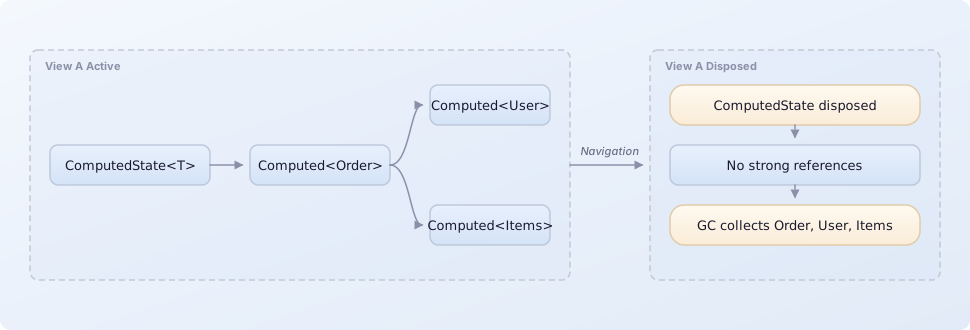
The process:
- Component disposal — When a Blazor component is disposed, it calls
Dispose()on itsComputedState<T> - Update loop stops — The state's auto-update loop terminates
- References released — The state no longer holds the
Computed<T>it was tracking - Cascade to dependencies — If no other code references the computed value or its dependencies, they become eligible for GC
- Memory freed — The next garbage collection reclaims all unreferenced computed values
Example: Blazor Component Lifecycle
cs
public class OrderDetailsComponent : ComputedStateComponent<OrderMM>
{
    [Inject] public IOrderServiceMM OrderService { get; set; } = null!;
    [Parameter] public long OrderId { get; set; }

    protected override async Task<OrderMM> ComputeState(CancellationToken ct)
    {
        // This creates/uses Computed<Order> which depends on:
        // - Computed<User> (for the order's customer)
        // - Computed<List<OrderItem>> (for the order's items)
        return await OrderService.Get(OrderId, ct);
    }
}
When the user navigates away:
- Blazor disposes
OrderDetailsComponent - The base class disposes its internal
ComputedState<Order> - The
Computed<Order>for this specificOrderIdloses its strong reference - All dependencies (
Computed<User>,Computed<List<OrderItem>>) also lose their strong references (unless used elsewhere) - On next GC, all these computed values are collected
Important: If another component is still displaying the same OrderId, the computed values remain alive because that component's state still references them.
Explicit Caching with MinCacheDuration
For values that should survive brief periods without references, use MinCacheDuration:
cs
public partial class Service3 : IComputeService
{
    [ComputeMethod]
    public virtual async Task<string> Get(string key)
    {
        WriteLine($"{nameof(Get)}({key})");
        return key;
    }

    [ComputeMethod(MinCacheDuration = 0.3)] // MinCacheDuration was added
    public virtual async Task<string> Combine(string key1, string key2)
    {
        WriteLine($"{nameof(Combine)}({key1}, {key2})");
        return await Get(key1) + await Get(key2);
    }
}
cs
var service = CreateServices().GetRequiredService<Service3>();
WriteLine(await service.Combine("a", "b"));
WriteLine(await service.Get("a"));
WriteLine(await service.Get("x"));
GC.Collect();
WriteLine("GC.Collect()");
WriteLine(await service.Combine("a", "b"));
WriteLine(await service.Get("a"));
WriteLine(await service.Get("x"));
await Task.Delay(1000);
GC.Collect();
WriteLine("Task.Delay(...) and GC.Collect()");
WriteLine(await service.Combine("a", "b"));
WriteLine(await service.Get("a"));
WriteLine(await service.Get("x"));
Output:
text
Combine(a, b)
Get(a)
Get(b)
ab
a
Get(x)
x
GC.Collect()
ab
a
Get(x)
x
Task.Delay(...) and GC.Collect()
Combine(a, b)
Get(a)
Get(b)
ab
a
Get(x)
x
The MinCacheDuration of 0.3 seconds:
- Keeps
Combine("a", "b")(and its dependenciesGet("a"),Get("b")) alive after the firstGC.Collect() - But after the 1-second delay, the cache duration expires, and the next
GC.Collect()removes everything
See ComputedOptions for all caching options.
Summary
| Scenario | Memory Behavior |
|---|---|
| No references to computed value | Collected on next GC |
Variable holds Computed<T> | Stays alive with all dependencies |
ComputedState<T> tracking value | Stays alive until state is disposed |
| UI component using computed state | Freed when component is disposed |
MinCacheDuration set | Stays alive for specified duration |
| Invalidated computed | Strong reference removed early (no point caching stale data) |
Best Practices
- Let the GC work — Don't manually cache computed values; Fusion's dependency tracking handles this automatically
- Dispose states — Always dispose
ComputedState<T>instances to stop update loops and release references - Use MinCacheDuration for hot paths — Apply it to frequently accessed values that are expensive to compute
- Prefer immutable return types — Records and immutable objects allow sharing without copying
- Don't hold old computed values — They reference the dependency graph, preventing GC of the entire tree