
Appearance
RPC Serialization Formats
ActualLab.Rpc supports multiple serialization formats with automatic version negotiation between clients and servers. This enables gradual upgrades and interoperability between different Fusion versions.
Overview
RPC serialization has two layers:
- Argument serialization: How method arguments are encoded
- Message serialization: How RPC messages (containing arguments) are framed
Each combination of these is packaged as an RpcSerializationFormat.
Available Formats
Text Formats (JSON)
| Format | Key | Description |
|---|---|---|
SystemJsonV5 | json5 | System.Text.Json with V4 arguments, V3 messages |
SystemJsonV5NP | json5np | System.Text.Json, no-polymorphism variant (plain JSON, no TypeRef wrapper) |
NewtonsoftJsonV5 | njson5 | Newtonsoft.Json with V4 arguments, V3 messages |
NewtonsoftJsonV5NP | njson5np | Newtonsoft.Json, no-polymorphism variant (plain JSON, no TypeRef wrapper) |
The "NP" (no-polymorphism) variants skip the type-decorating TypeRef wrapper entirely, producing plain JSON without type metadata. Use them when all argument and result types are concrete (non-abstract) and no polymorphic dispatch is needed.
Binary Formats (MemoryPack)
| Format | Key | Description |
|---|---|---|
MemoryPackV5 | mempack5 | V4 args, V4 messages |
MemoryPackV5C | mempack5c | Compact variant of V5 |
MemoryPackV6 | mempack5 | V4 args, V5 messages |
MemoryPackV6C | mempack5c | Compact variant of V5 |
Binary Formats (MessagePack)
| Format | Key | Description |
|---|---|---|
MessagePackV5 | msgpack5 | V4 args, V4 messages |
MessagePackV5C | msgpack5c | Compact variant of V5 |
MessagePackV6 | msgpack5 | V4 args, V5 messages |
MessagePackV6C | msgpack5c | Compact variant of V5 |
Binary Formats (Nerdbank.MessagePack)
These formats require the ActualLab.Serialization.NerdbankMessagePack package. They are not registered by default — call RpcNerdbankSerializationFormat.Register() at startup to enable them.
| Format | Key | Description |
|---|---|---|
NerdbankMessagePackV6 | nmsgpack6 | Nerdbank.MessagePack, V4 args, V5 messages |
NerdbankMessagePackV6C | nmsgpack6c | Compact variant of V6 |
Format Selection
Default Format
The default format is typically MemoryPackV5C (or latest version) for .NET 6+ and MessagePackV5C for .NET Standard.
Client-Server Negotiation
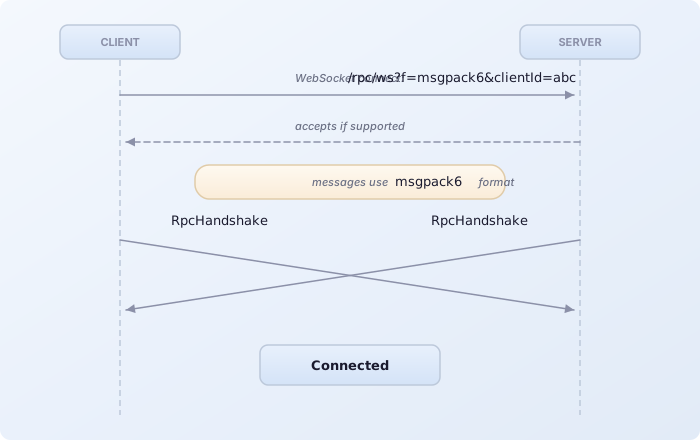
When a client connects, it requests its preferred serialization format via a URL parameter (e.g., <endpoint>?f=msgpack6&clientId=...). The server accepts the connection if it supports that format. Once connected, both parties simultaneously exchange RpcHandshake messages:
Accessing All Formats
cs
// All registered formats
ImmutableList<RpcSerializationFormat> all = RpcSerializationFormat.All;

// Find by key
var format = RpcSerializationFormat.All.First(f => f.Key == "mempack6c");
Format Structure
Each RpcSerializationFormat consists of:
cs
public sealed class RpcSerializationFormatExample(
    string key,
    Func<RpcArgumentSerializer> argumentSerializerFactory,
    Func<RpcPeer, RpcMessageSerializer> messageSerializerFactory)
{
    public string Key { get; } = key;
    public RpcArgumentSerializer ArgumentSerializer { get; } = argumentSerializerFactory();
    public Func<RpcPeer, RpcMessageSerializer> MessageSerializerFactory { get; } = messageSerializerFactory;
}| Property | Description |
|---|---|
Key | Unique string identifier for negotiation |
ArgumentSerializer | Serializes method arguments |
MessageSerializerFactory | Creates message serializers per peer |
Version Differences
Argument Serializer Versions
| Version | Description |
|---|---|
| V4 | Latest, best performance |
Message Serializer Versions
| Version | Variants | Description |
|---|---|---|
| V4 | Normal, Compact | Was optimal up to Fusion v11.5.X |
| V5 | Normal, Compact | Saves 1 byte per message over V4 |
Compact vs Normal
Compact variants (*C suffix) use smaller message framing at a slight CPU cost. Choose compact for:
- Lower bandwidth scenarios
- When message overhead is significant relative to payload
Configuring Formats
Enabling Nerdbank.MessagePack Formats
Add the ActualLab.Serialization.NerdbankMessagePack package and call Register() at startup:
cs
// Register nmsgpack6 / nmsgpack6c formats
RpcNerdbankSerializationFormat.Register();
Registering Additional Formats
cs
RpcSerializationFormat.All = RpcSerializationFormat.All.Add(
    new RpcSerializationFormat(
        "custom",
        () => new MyArgumentSerializer(),
        peer => new MyMessageSerializer(peer)));
Removing Formats
To disable older formats for security:
cs
// To disable older formats for security:
RpcSerializationFormat.All = RpcSerializationFormat.All
    .RemoveAll(f => f.Key.StartsWith("mempack5") || f.Key.StartsWith("msgpack5"));
Format Selection Factors
When choosing formats, consider:
| Factor | Recommendation |
|---|---|
| Performance | Binary formats (MemoryPack > MessagePack > JSON) |
| Debugging | JSON formats (human-readable) |
| Compatibility | MessagePack for .NET Standard clients |
| Bandwidth | Compact variants (*C) |
| Security | Latest versions, disable V1 |
Serialization in RPC Pipeline

- Client serializes method arguments using
ArgumentSerializer - Arguments are wrapped in an
RpcMessageand serialized byMessageSerializer - Binary data is sent over WebSocket
- Server deserializes in reverse order
Polymorphic Serialization
By default, ActualLab.Rpc treats abstract types and object as polymorphic. When a method argument or result is polymorphic, the serializer wraps it with a TypeRef so the actual runtime type can be restored on the other side.
This is determined by RpcArgumentSerializer.IsPolymorphic(Type):
cs
// These are considered polymorphic by default:
IsPolymorphic(typeof(ITuple))  // true - it's an interface (abstract)
IsPolymorphic(typeof(object))  // true

// Concrete types are not:
IsPolymorphic(typeof(string))  // false
IsPolymorphic(typeof(int))     // false
Opting Out with [RpcSerializable]
When the underlying serializer already handles polymorphism (e.g., via [JsonDerivedType], [MemoryPackUnion], or [Union]), the RPC layer's TypeRef wrapping is redundant overhead. Apply [RpcSerializable] to the base type to tell RPC that the type can be serialized directly:
cs
// The underlying serializers handle polymorphism via union attributes,
// so we mark this type as RPC-serializable to opt out of TypeRef wrapping.
[RpcSerializable]
[MemoryPackable]
[MemoryPackUnion(0, typeof(ShapeCircle))]
[MemoryPackUnion(1, typeof(ShapeRect))]
[MessagePackObject]
[Union(0, typeof(ShapeCircle))]
[Union(1, typeof(ShapeRect))]
[JsonDerivedType(typeof(ShapeCircle), "circle")]
[JsonDerivedType(typeof(ShapeRect), "rect")]
public abstract partial class Shape
{
    [DataMember, MemoryPackOrder(0), Key(0)]
    public string? Name { get; set; }
}

[DataContract, MemoryPackable(GenerateType.VersionTolerant), MessagePackObject]
public partial class ShapeCircle : Shape
{
    [DataMember, MemoryPackOrder(1), Key(1)]
    public double Radius { get; set; }
}

[DataContract, MemoryPackable(GenerateType.VersionTolerant), MessagePackObject]
public partial class ShapeRect : Shape
{
    [DataMember, MemoryPackOrder(1), Key(1)]
    public double Width { get; set; }

    [DataMember, MemoryPackOrder(2), Key(2)]
    public double Height { get; set; }
}
With this attribute, RpcArgumentSerializer.IsPolymorphic(typeof(Shape)) returns false, so methods like Task<Shape> GetShape(...) use regular serialization. The discriminated union support in each serializer takes care of preserving the actual runtime type.
The attribute uses Inherited = true, so derived types also inherit the opt-out.
When to Use
Use [RpcSerializable] when:
- Your abstract base type or interface has serializer-level union support (
[JsonDerivedType],[MemoryPackUnion],[Union]) - You want to avoid the overhead of RPC's
TypeRefwrapping - All concrete subtypes are declared in the union configuration
Related Topics
- Core Serialization - General serialization infrastructure
- RPC Key Concepts - RPC architecture overview
- Configuration Options - RPC configuration