Appearance
ActualLab.Rpc Key Concepts
This document describes the key abstractions in ActualLab.Rpc that power distributed compute services.
Overview
ActualLab.Rpc is built around a few core abstractions:
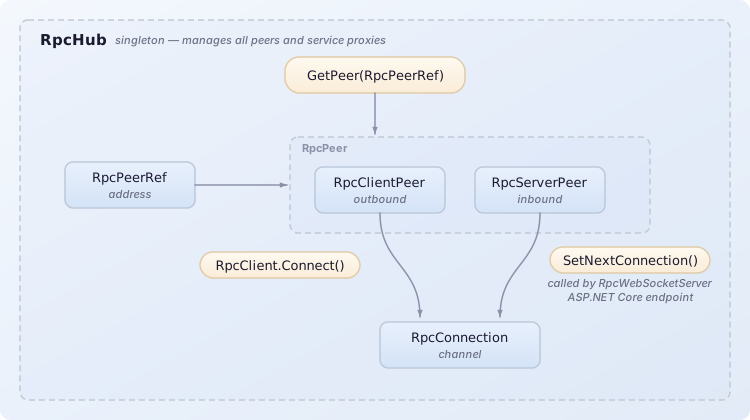
RpcHub
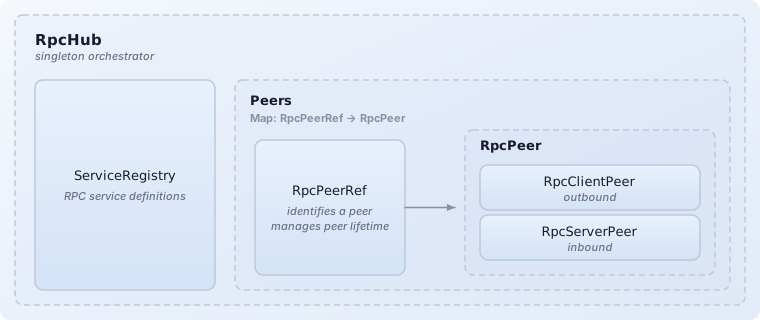
RpcHub is the central orchestrator for the entire RPC system. It's registered as a singleton in DI and manages:
- Peer connections and their lifecycle
- RPC service client and server proxies
- Configuration, serialization formats, and middleware
Key Properties
| Property | Description |
|---|---|
Configuration | RPC configuration settings |
ServiceRegistry | Registry of RPC service definitions |
SerializationFormats | Available serialization format resolvers |
Peers | Collection of active peer instances |
DefaultPeer | The default peer for outbound calls |
LoopbackPeer | Peer for in-process loopback connections - for use in tests only |
LocalPeer | Peer for local (same-process) calls |
Key Methods
csharp
// Get or create a peer by reference
RpcPeer GetPeer(RpcPeerRef peerRef);

// Get specifically typed peers
RpcClientPeer GetClientPeer(RpcPeerRef peerRef);
RpcServerPeer GetServerPeer(RpcPeerRef peerRef);

// Get RPC service proxies
TService GetClient<TService>() where TService : class, IRpcService;
TService GetServer<TService>() where TService : class, IRpcService;
Usage Example
csharp
// Get RpcHub from DI
var rpcHub = services.GetRequiredService<RpcHub>();

// Get a client proxy for a service
var userService = rpcHub.GetClient<IUserService>();

// Get default peer
var defaultPeer = rpcHub.DefaultPeer;
RpcPeerRef
RpcPeerRef is an immutable reference that identifies a remote or local peer. Think of it as an "address" for an RPC endpoint.
Key Properties
| Property | Description |
|---|---|
Address | Unique address string identifying the peer |
IsServer | Whether this refers to a server-side peer |
IsBackend | Whether this is a backend (internal) peer |
ConnectionKind | Type of connection (Remote, Loopback, Local, None) |
SerializationFormat | Name of serialization format to use |
HostInfo | Host identifier (URL or other identifier) |
Versions | Supported API versions |
Well-Known Peer Refs
csharp
RpcPeerRef.Default   // Default remote peer
RpcPeerRef.Loopback  // In-process loopback
RpcPeerRef.Local     // Local (same-process) calls
RpcPeerRef.None      // No peer (null object)
Creating Peer Refs
csharp
// Create a client peer ref (for outbound connections)
var clientRef = RpcPeerRef.NewClient(hostInfo: "https://api.example.com");

// Create a server peer ref (for inbound connections)
var serverRef = RpcPeerRef.NewServer(hostInfo: "client-123");

// Peer refs must be initialized before use
clientRef = clientRef.Initialize();
RpcPeer
RpcPeer is the abstract base class that manages an actual connection to a peer. It handles:
- Connection lifecycle (connect, disconnect, reconnect)
- Handshake exchange
- Message processing
- Call tracking
Key Properties
| Property | Description |
|---|---|
Hub | Reference to the parent RpcHub |
Ref | The RpcPeerRef this peer represents |
Id | Unique Guid for this peer instance |
ConnectionState | Current connection state (AsyncState) |
ConnectionKind | Type of connection |
Versions | Supported API versions |
SerializationFormat | Current serialization format |
InboundCalls | Tracker for incoming RPC calls |
OutboundCalls | Tracker for outgoing RPC calls |
Key Methods
csharp
// Send a message to the peer
void Send(RpcMessage message, ChannelWriter<RpcMessage>? sender = null);

// Check connection status
bool IsConnected();

// Wait for connection to be established
Task<(RpcHandshake Handshake, RpcTransport Transport)> WhenConnected(CancellationToken cancellationToken = default);

// Disconnect the peer
Task Disconnect(Exception? error = null, CancellationToken cancellationToken = default);
Concrete Implementations
RpcClientPeer
Represents a client-side outbound connection. It:
- Initiates connections to remote servers
- Handles reconnection with exponential backoff
- Has a unique
ClientIdfor identification
csharp
public sealed class RpcClientPeer : RpcPeer
{
    public string ClientId { get; }           // Unique client identifier
    public AsyncState<Moment> ReconnectsAt;   // Next reconnection time
}
RpcServerPeer
Represents a server-side inbound connection. It:
- Waits for connections to be provided by the server framework
- Receives connections via
SetNextConnection()
csharp
public sealed class RpcServerPeer : RpcPeer
{
    // Called by server framework when a client connects
    public Task SetNextConnection(RpcConnection connection, CancellationToken cancellationToken);
}
RpcConnection
RpcConnection wraps a message channel for transport. It encapsulates:
- A
Channel<RpcMessage>for bidirectional communication - Connection metadata via
Properties - Connection type indicator (
IsLocal)
csharp
public sealed class RpcConnection
{
    public Channel<RpcMessage> Channel { get; }
    public PropertyBag Properties { get; }
    public bool IsLocal { get; }
}
RpcPeerConnectionState
An immutable snapshot of a peer's connection state at a point in time.
Key Properties
| Property | Description |
|---|---|
Connection | Current RpcConnection |
Handshake | Remote peer's handshake info |
OwnHandshake | Local peer's handshake info |
Error | Error if disconnected |
ConnectionAttemptIndex | Reconnection attempt number |
State Transitions
csharp
// Check if connected
bool IsConnected();

// Transition to connected state
RpcPeerConnectionState NextConnected(RpcConnection connection, RpcHandshake handshake);

// Transition to disconnected state
RpcPeerConnectionState NextDisconnected(Exception? error);
RpcHandshake
Immutable handshake message exchanged when a connection is established. It enables peer identification and compatibility checking.
Key Properties
| Property | Description |
|---|---|
RemotePeerId | Guid of the remote peer |
RemoteApiVersionSet | Supported API versions |
RemoteHubId | Guid of the remote RpcHub |
ProtocolVersion | RPC protocol version |
Index | Handshake sequence number |
RpcMessage
Immutable serializable message that carries RPC calls and responses.
Key Properties
| Property | Description |
|---|---|
CallTypeId | Type of call (request, response, system) |
RelatedId | Links requests to responses |
MethodRef | RPC method being called |
ArgumentData | Serialized argument bytes |
Headers | Optional RPC headers |
RpcClient
Abstract service for establishing client-side connections.
Key Methods
csharp
// Establish a remote connection (e.g., WebSocket)
protected abstract Task<RpcConnection> ConnectRemote(
    RpcClientPeer peer,
    CancellationToken cancellationToken);

// Create an in-process loopback connection pair
protected virtual Task<RpcConnection> ConnectLoopback(
    RpcClientPeer peer,
    CancellationToken cancellationToken);
The primary implementation is RpcWebSocketClient, which establishes WebSocket connections.
IRpcService
Marker interface for RPC services. Any service that should be callable via RPC must implement this interface:
csharp
public interface IUserService : IRpcService
{
    Task<User?> GetUser(long id, CancellationToken cancellationToken = default);
    Task UpdateUser(long id, User user, CancellationToken cancellationToken = default);
}
Connection Lifecycle
1. RpcHub.GetPeer(peerRef) creates or retrieves RpcPeer
                │
2. RpcClientPeer.GetConnection() establishes connection
   └── RpcClient.ConnectRemote() or ConnectLoopback()
                │
3. Handshake exchange (RpcHandshake)
   └── Both peers send their handshake info
                │
4. Message processing loop
   └── RpcMessage sent/received via Channel
                │
5. On disconnect: reconnection with exponential backoff
   └── RpcClientPeer tracks ReconnectsAt
Relationship Diagram