
Appearance
Call Routing
ActualLab.Rpc supports flexible call routing, enabling scenarios like:
- Sharding – Route calls to specific servers based on a shard key
- Load balancing – Distribute calls across multiple backend servers
- Affinity routing – Route calls based on user ID, entity ID, or other attributes
- Dynamic topology – Handle server additions/removals without client restarts
Core Concepts
RouterFactory
The RouterFactory is the entry point for custom routing. It's configured via RpcOutboundCallOptions:
cs
services.AddSingleton(_ => RpcOutboundCallOptions.Default with {
    RouterFactory = methodDef => args => {
        // Return RpcRef based on method and arguments
        return RpcRef.Default;
    }
});
The factory receives an RpcMethodDef and returns a function that maps ArgumentList to RpcRef. This two-level design allows you to:
- Inspect the method definition once (outer function)
- Make per-call routing decisions based on arguments (inner function)
RpcRef
RpcRef identifies the target peer for a call:
| Type | Description |
|---|---|
RpcRef.Default | The default remote peer (for single-server scenarios) |
RpcRef.Local | Execute locally (bypass RPC) |
RpcRef.Loopback | In-process loopback (for testing) |
Custom RpcRef | Your own peer reference, optionally with a resettable route |
RpcRef instances are stable: there is one ref per logical target (shard, host, "default"), so you can cache them forever and return them from routers with no extra ceremony. When the target moves (e.g., a shard-map change), the ref itself doesn't change — its route (see below) is reset instead.
RpcPeerRef: renamed to RpcRef in v14.1
Starting from v14.1, RpcPeerRef is replaced by the RpcRef + RpcRoute pair:
| Before v14.1 | v14.1+ |
|---|---|
RpcPeerRef | RpcRef (stable; one instance per logical target) |
RpcRouteState | RpcRoute (one instance per route generation) |
RpcPeerRef.RouteState | RpcRef.Route (re-minted via CreateRoute() on change) |
RpcPeerRefBuilder (TS, @actuallab/rpc) | RpcRefBuilder (TS refs stay plain strings; no route concept) |
RpcRouteStateExt | Merged into RpcRoute (IsChanged, RerouteIfChanged, etc.) |
RpcPeer.Ref.RouteState | RpcPeer.Route (the generation the peer is bound to) |
The key semantic change: refs used to be re-created on every topology change, so caches had to version and re-mint them; now the ref is permanent and only its route is reset.
RpcRoute
RpcRoute represents one route generation of an RpcRef: it carries the resolved target info for that generation and signals when the route changes. A ref becomes reroutable by overriding CreateRoute():
cs
public class MyPeerRef : RpcRef
{
    public MyPeerRef(string targetId)
    {
        HostInfo = targetId;
        Initialize(); // Mints the first route via CreateRoute()
    }

    protected override RpcRoute CreateRoute()
    {
        var route = new MyRoute(this); // Resolves the current target
        // Start monitoring for topology changes; each generation gets its own watcher
        _ = Task.Run(async () => {
            await WaitForTopologyChange(route.ChangedToken);
            route.MarkChanged(); // Triggers rerouting
        });
        return route;
    }
}Initialize()callsCreateRoute()once; the base implementation returnsRpcRoute.NewStatic(this)— a static route (IsStatic == true) that is never marked as changed, so no rerouting logic is engaged (that's what plain client and server refs use).- The
RpcRef.Routegetter re-mints lazily: when the current route is marked as changed, the next read invokesCreateRoute()for the next generation. A burst of topology churn with no interleaved calls therefore coalesces into a single re-resolution. RpcRef.Reset()marks the current route as changed and eagerly mints the next one.- Each
RpcPeercaptures the route it was created for inRpcPeer.Route, so a draining peer keeps observing its own generation whileref.Routealready points to the next one.
When route.MarkChanged() is called:
- The
RpcPeerbound to that route generation is disposed - Active calls on that peer receive
RpcRerouteException - The RPC interceptor catches the exception
- After a delay (
ReroutingDelays), the call is rerouted viaRouterFactory, which resolves the same stable ref — now with a freshly minted route
RpcRerouteException
RpcRerouteException signals that a call must be rerouted to a different peer. It's thrown automatically when:
MarkChanged()is called on the route of the peer serving the call- An inbound call arrives at a server that's no longer responsible for the shard/entity
cs
// Throwing manually (e.g., in a service method)
throw RpcRerouteException.MustReroute("Target server changed");
Simple Example: Hash-Based Routing
This example from the MultiServerRpc sample routes chat calls based on chat ID hash:
cs
const int serverCount = 2;
var serverUrls = Enumerable.Range(0, serverCount)
    .Select(i => $"http://localhost:{22222 + i}/")
    .ToArray();
var clientPeerRefs = serverUrls
    .Select(url => RpcRef.NewClient(url))
    .ToArray();

services.AddSingleton(_ => RpcOutboundCallOptions.Default with {
    RouterFactory = methodDef => args => {
        if (methodDef.Service.Type == typeof(IChat)) {
            var arg0Type = args.GetType(0);
            int hash;
            if (arg0Type == typeof(string))
                hash = args.Get<string>(0).GetXxHash3();
            else if (arg0Type == typeof(Chat_Post))
                hash = args.Get<Chat_Post>(0).ChatId.GetXxHash3();
            else
                throw new NotSupportedException("Can't route this call.");

            return clientPeerRefs[hash.PositiveModulo(serverCount)];
        }
        return RpcRef.Default;
    }
});
Key points:
- Routes
IChatcalls based on the first argument (chat ID or command) - Uses
GetXxHash3()for consistent hashing (doesn't change between runs) - Falls back to
RpcRef.Defaultfor other services
Advanced Example: Dynamic Mesh Routing
The MeshRpc sample demonstrates dynamic routing with automatic rerouting when topology changes.
Custom stable PeerRef with a resettable route
cs
public sealed class RpcShardRef : RpcRef
{
    private static readonly ConcurrentDictionary<ShardRef, RpcShardRef> Cache = new();

    public ShardRef ShardRef { get; }

    public static RpcShardRef Get(ShardRef shardRef)
        => Cache.GetOrAdd(shardRef, static key => new RpcShardRef(key));

    private RpcShardRef(ShardRef shardRef)
    {
        ShardRef = shardRef;
        HostInfo = shardRef.ToString();
        UseReferentialEquality = true;
        Initialize(); // Mints the first RpcShardRoute
    }

    protected override RpcRoute CreateRoute()
        => new RpcShardRoute(this);
}

public sealed class RpcShardRoute : RpcRoute
{
    public string HostId { get; } // The resolved target of this route generation

    internal RpcShardRoute(RpcShardRef rpcRef) : base(rpcRef)
    {
        var meshState = MeshState.State.Value;
        HostId = meshState.GetShardHost(rpcRef.ShardRef)?.Id ?? "null";

        // Monitor for topology changes; the watcher dies with its route generation
        _ = Task.Run(async () => {
            var computed = MeshState.State.Computed;
            // Wait until this host is removed from the mesh
            await computed.When(x => !x.HostById.ContainsKey(HostId), ChangedToken);
            MarkChanged(); // Triggers rerouting; the next Route read mints a new RpcShardRoute
        });
    }

    // Makes the route render as "<address> [vN->hostId]" in logs
    protected override string GetTargetString()
        => HostId;
}
Note that the ref itself carries only the stable shard identity; the per-generation resolution (HostId) lives on the route. The cache is a plain GetOrAdd — no versioning, no IsChanged double-checks, no re-minting races in app code.
RouterFactory with Type-Based Routing
cs
public Func<ArgumentList, RpcRef> RouterFactory(RpcMethodDef methodDef)
    => args => {
        if (args.Length == 0)
            return RpcRef.Local;

        var arg0Type = args.GetType(0);

        // Route by HostRef
        if (arg0Type == typeof(HostRef))
            return RpcHostRef.Get(args.Get<HostRef>(0));
        if (typeof(IHasHostRef).IsAssignableFrom(arg0Type))
            return RpcHostRef.Get(args.Get<IHasHostRef>(0).HostRef);

        // Route by ShardRef
        if (arg0Type == typeof(ShardRef))
            return RpcShardRef.Get(args.Get<ShardRef>(0));
        if (typeof(IHasShardRef).IsAssignableFrom(arg0Type))
            return RpcShardRef.Get(args.Get<IHasShardRef>(0).ShardRef);

        // Route by hash of first argument
        if (arg0Type == typeof(int))
            return RpcShardRef.Get(ShardRef.New(args.Get<int>(0)));

        return RpcShardRef.Get(ShardRef.New(args.GetUntyped(0)));
    };
Rerouting Flow
When a peer's route state changes, the following sequence occurs:
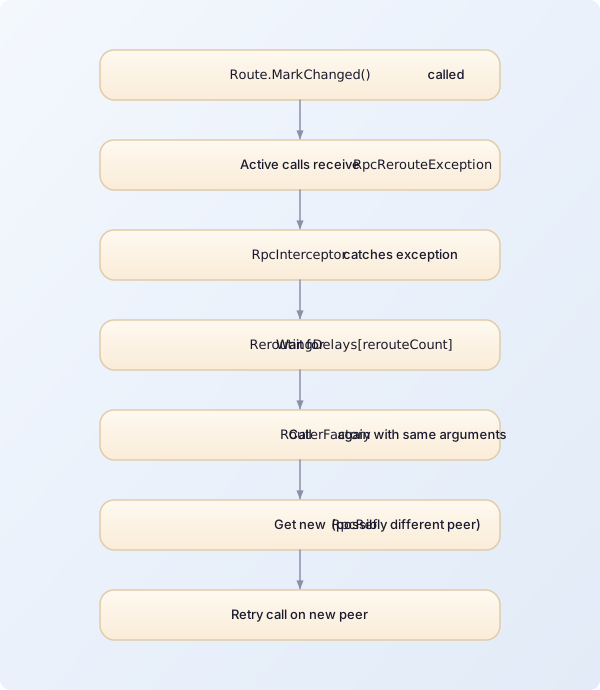
Local Execution Mode
When a call routes to the local server (via RpcRef.Local or a custom peer ref pointing to the current host), RpcLocalExecutionMode controls how local execution coordinates with rerouting signals.
This is only relevant for distributed services (RpcServiceMode.Distributed). Non-distributed services ignore this setting.
RpcLocalExecutionMode Values
| Mode | LocalExecutionAwaiter | Rerouting Check | Cancellation Token | Use Case |
|---|---|---|---|---|
Unconstrained | Not awaited | None | Original token | Non-distributed services, simple calls |
ConstrainedEntry | Awaited once | At entry point only | Original token | Compute services, where late reroutes are acceptable |
Constrained | Awaited | At entry + during execution | Linked to RpcRoute.ChangedToken | Long-running calls that must abort on reroute |
How It Works
When a call executes locally with an RpcRoute:
Unconstrained: Executes immediately without coordination. Use for calls where rerouting mid-execution is acceptable.
ConstrainedEntry: Waits for
LocalExecutionAwaiterbefore starting. If the route changed while waiting, throwsRpcRerouteException. Once execution starts, it won't be interrupted.Constrained: Same as
ConstrainedEntry, plus the cancellation token is linked toRpcRoute.ChangedToken. If the route changes during execution, the call is cancelled and rerouted. This is the most defensive mode.
Default Modes
The default mode depends on both the service mode and method type:
| Service Mode | Method Type | Default Mode | Rationale |
|---|---|---|---|
Distributed | Regular methods | Constrained | Commands may have side effects; must abort if route changes |
Distributed | Compute methods | ConstrainedEntry | Read-only; safe to complete locally even if route changes |
| Non-distributed | Any | Unconstrained | No rerouting concerns |
Why compute methods use ConstrainedEntry:
Compute methods (methods returning Task<T> on IComputeService) are read-only operations that produce cached computed values. If a compute method starts executing locally and the route changes mid-execution:
- The client (i.e., another server that requests the value) will notice the change in topology and terminate the peer responsible for the call, which triggers rerouting of all its open calls and invalidation of compute method calls awaiting invalidation.
- So at worst, a redundant computation occurs on the "wrong" (old) server.
Using Constrained would unnecessarily cancel the computation, which isn't much better than a subsequent rerouting.
Why regular distributed methods use Constrained:
Regular methods on distributed services often perform commands with side effects (database writes, state mutations). If a route changes mid-execution:
- The operation might complete on a server no longer responsible for the data
- This could cause inconsistencies in a sharded system
- Aborting and rerouting ensures the correct server handles the operation
Resolution order:
- Method-level
[RpcMethod(LocalExecutionMode = ...)]attribute - Service-level configuration via
HasLocalExecutionMode() - Auto-default based on service mode and method type
Configuration
Configure at the service level:
cs
services.AddRpc()
    .AddDistributed<IMyService, MyServiceImpl>()
    .HasLocalExecutionMode(RpcLocalExecutionMode.ConstrainedEntry);
Override at the method level using RpcMethodAttribute:
cs
public interface IMyService : IRpcService
{
    // Use Unconstrained for this specific fast method
    [RpcMethod(LocalExecutionMode = RpcLocalExecutionMode.Unconstrained)]
    Task<int> GetCount(string key, CancellationToken ct);

    // Use full Constrained for this long-running method
    [RpcMethod(LocalExecutionMode = RpcLocalExecutionMode.Constrained)]
    Task<Report> GenerateReport(ReportRequest request, CancellationToken ct);
}
When to Use Each Mode
Unconstrained: For fast, idempotent operations where executing on the "wrong" server temporarily is acceptable. Also used internally for NoWait calls and system calls.
ConstrainedEntry: For compute methods or operations that are safe to complete locally even if the route changes mid-execution. The result may be discarded, but no side effects occur.
Constrained: For operations with side effects (database writes, external API calls) that must not complete on a server that's no longer responsible for the data. This ensures consistency during topology changes.
Remote Execution Mode
While RpcLocalExecutionMode (above) governs how local execution coordinates with rerouting, RpcRemoteExecutionMode governs how remote outbound calls behave with respect to the underlying connection: whether they wait for the peer to be connected, whether they resume after a reconnect, and whether they survive a change in peer identity.
It's a [Flags] enum, so values can be combined with |.
RpcRemoteExecutionMode Values
| Flag | Value | When set | When unset |
|---|---|---|---|
AwaitForConnection | 1 | Wait for the peer to connect if it's disconnected when the call is made | The call fails immediately if the peer isn't connected |
AllowReconnect | 2 | Resend the call after reconnecting to the same peer | The call is aborted on disconnect |
AllowResend | 6 (4 | AllowReconnect) | Resend the call even after reconnecting to a different peer (implies AllowReconnect) | The call is aborted when peer identity changes |
Default | 7 (AwaitForConnection | AllowResend) | Wait, reconnect, and resend — the default for regular outbound calls |
Special cases:
NoWaitmethods always use0regardless of this setting — they're fire-and-forget by design.- Compute methods must use
Default. Any other value is rejected at registration time, because compute-call semantics rely on the call eventually reaching some responsible peer.
Resolution order (same as for RpcLocalExecutionMode):
- Method-level
[RpcMethod(RemoteExecutionMode = ...)]attribute - Service-level configuration via
HasRemoteExecutionMode() RpcRemoteExecutionMode.Default
Configuration
Configure at the service level:
cs
services.AddRpc()
    .AddClient<IMyService>()
    .HasRemoteExecutionMode(RpcRemoteExecutionMode.AwaitForConnection);
Override at the method level using RpcMethodAttribute:
cs
public interface IMyService : IRpcService
{
    // Fail fast if disconnected; don't resend on reconnect
    [RpcMethod(RemoteExecutionMode = RpcRemoteExecutionMode.AwaitForConnection)]
    Task<Quote> GetLiveQuote(string symbol, CancellationToken ct);

    // Fire-and-forget: mode is forced to 0 regardless of the attribute
    Task<RpcNoWait> Ping();

    // Full default: wait, reconnect, and resend even across peer changes
    [RpcMethod(RemoteExecutionMode = RpcRemoteExecutionMode.Default)]
    Task<Report> GenerateReport(ReportRequest request, CancellationToken ct);
}
TypeScript
The same enum — with identical numeric values — is available in the TypeScript client (@actuallab/rpc). It can be applied either through defineRpcService(...) or through the @rpcMethod(...) decorator:
ts
import {
    defineRpcService, RpcRemoteExecutionMode, RpcType, rpcMethod, rpcService,
} from '@actuallab/rpc';

// Via defineRpcService
const MyServiceDef = defineRpcService('MyService', {
    getLiveQuote: {
        args: ['symbol'],
        remoteExecutionMode: RpcRemoteExecutionMode.AwaitForConnection,
    },
    generateReport: {
        args: ['request'],
        // remoteExecutionMode: RpcRemoteExecutionMode.Default is the default
    },
    ping: { args: [], returns: RpcType.noWait }, // always uses 0
});

// Or via decorators
@rpcService('MyService')
class MyServiceClient {
    @rpcMethod({ remoteExecutionMode: RpcRemoteExecutionMode.AwaitForConnection })
    getLiveQuote(symbol: string): Promise<Quote> { /* ... */ }
}
Flag values on the TS side match .NET exactly: AwaitForConnection = 1, AllowReconnect = 2, AllowResend = 6, Default = 7. NoWait methods are likewise forced to 0.
Configuration
Rerouting Delays
Configure delays between rerouting attempts via RpcOutboundCallOptions:
cs
services.AddSingleton(_ => RpcOutboundCallOptions.Default with {
    ReroutingDelays = RetryDelaySeq.Exp(0.1, 5), // 0.1s to 5s exponential backoff
});
The delay sequence uses exponential backoff to avoid overwhelming the system during topology changes.
Host URL Resolution
When using custom RpcRef types, configure how to resolve the actual host URL. Read the peer's route (peer.Route) rather than the ref's current one — the peer must keep connecting to the target of its own route generation:
cs
services.Configure<RpcWebSocketClientOptions>(o => {
    o.HostUrlResolver = peer => {
        if (peer.Route is RpcShardRoute rpcShardRoute) {
            var host = GetHostById(rpcShardRoute.HostId);
            return host?.Url ?? "";
        }
        return peer.Ref.HostInfo;
    };
});
Connection Kind Detection
Detect whether a peer points to a local or remote target. The detector receives the route generation the peer is created for (its ref is route.Ref); it's consulted only when the route doesn't specify a ConnectionKind on its own:
cs
services.Configure<RpcPeerOptions>(o => {
    o.ConnectionKindDetector = route => {
        if (route is RpcShardRoute rpcShardRoute)
            return rpcShardRoute.HostId == currentHostId
                ? RpcPeerConnectionKind.Local
                : RpcPeerConnectionKind.Remote;

        return route.Ref.ConnectionKind;
    };
});
Alternatively, when each process resolves routes only for itself, set RpcRoute.ConnectionKind directly in CreateRoute() — it takes precedence over the detector.
Best Practices
Cache PeerRefs – Create and reuse
RpcRefinstances for the same routing key. Since refs are stable, a plainConcurrentDictionary.GetOrAddis all you need.Use consistent hashing – Use
GetXxHash3()or similar stable hash functions.string.GetHashCode()varies between runs.Handle topology changes gracefully – Override
CreateRoute()and callMarkChanged()on the route to automatically reroute when servers come and go.Monitor rerouting – Rerouting is logged at Warning level. High rerouting rates may indicate topology instability.
Consider local execution – Return
RpcRef.Localwhen the call can be handled by the current server to avoid network overhead.